M11 Vektoren: Unterschied zwischen den Versionen
| Zeile 51: | Zeile 51: | ||
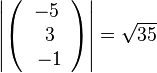
{{Lösung versteckt|1=a) <math>\left | \left ( \begin{array}{c} -5 \\\ 3 \\\ -1 \end{array}\right) \right | = \sqrt {35} </math>, b) <math> \left | \left ( \begin{array}{c} -1 \\\ 6 \\\ 0 \end{array}\right) \right | = \sqrt {37}</math>, c) <math> \left | \left ( \begin{array}{c} 2 \\\ 4 \\\ -3 \end{array}\right ) \right | = \sqrt {29}</math> , d) <math>\left | \left ( \begin{array}{c} 0 \\\ 0 \\\ 0 \end{array}\right) \right | = \sqrt {0} = 0</math>, e) <math>\left | \left ( \begin{array}{c} 0 \\\ 4 \\\ -3 \end{array}\right) \right | = \sqrt {25} = 5</math> }} | {{Lösung versteckt|1=a) <math>\left | \left ( \begin{array}{c} -5 \\\ 3 \\\ -1 \end{array}\right) \right | = \sqrt {35} </math>, b) <math> \left | \left ( \begin{array}{c} -1 \\\ 6 \\\ 0 \end{array}\right) \right | = \sqrt {37}</math>, c) <math> \left | \left ( \begin{array}{c} 2 \\\ 4 \\\ -3 \end{array}\right ) \right | = \sqrt {29}</math> , d) <math>\left | \left ( \begin{array}{c} 0 \\\ 0 \\\ 0 \end{array}\right) \right | = \sqrt {0} = 0</math>, e) <math>\left | \left ( \begin{array}{c} 0 \\\ 4 \\\ -3 \end{array}\right) \right | = \sqrt {25} = 5</math> }} | ||
| + | |||
| + | {{Aufgaben-blau|3|2=Buch S. 93 / 1 d, e | ||
| + | |||
| + | {{Lösung versteckt|1=d) <math>\vec {AB} = \vec B-\vec A = \left ( \begin{array}{c} 4 \\\ -4 \\\ 0 \end{array}\right) - \left ( \begin{array}{c} 2 \\\ -4 \\\ -5 \end{array}\right) = \left ( \begin{array}{c} 2 \\\ 0 \\\ 5 \end{array}\right)</math> <br> | ||
| + | <math>\vec {BA} = \vec A-\vec B = \left ( \begin{array}{c} 2 \\\ -4 \\\ -5 \end{array}\right) - \left ( \begin{array}{c} 4 \\\ -4 \\\ 0 \end{array}\right) = \left ( \begin{array}{c} -2 \\\ 0 \\\ -5 \end{array}\right)</math> <br> | ||
| + | e) <math>\vec {AB} = \vec B-\vec A = \left ( \begin{array}{c} -4 \\\ -8 \\\ 0 \end{array}\right) - \left ( \begin{array}{c} 0 \\\ 8 \\\ -2 \end{array}\right) = \left ( \begin{array}{c} -4 \\\ -16 \\\ 2 \end{array} \right)</math> <br> | ||
| + | <math>\vec {BA} = \vec A-\vec B = \left ( \begin{array}{c} 2 \\\ 3 \\\ -5 \end{array}\right) - \left ( \begin{array}{c} -4 \\\ -8 \\\ 0 \end{array}\right) = \left ( \begin{array}{c} 4 \\\ 16 \\\ -2 \end{array} \right)</math> | ||
| + | |||
| + | Es ist <math>\vec {BA} = -\vec {AB}</math> }} | ||
| + | |||
| + | Buch S. 93 / 2 | ||
| + | |||
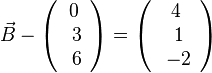
| + | {{Lösung versteckt|1=a) <math>\vec {AB} = \vec B-\vec A = \left ( \begin{array}{c} 4 \\\ 1 \\\ -2 \end{array}\right)</math>, also <math>\vec B - \left ( \begin{array}{c} 0 \\\ 3 \\\ 6 \end{array}\right) = \left ( \begin{array}{c} 4 \\\ 1 \\\ -2 \end{array}\right)</math> oder <math>\left ( \begin{array}{c} b_1 \\\ b_2 \\\ b_3 \end{array}\right) - \left ( \begin{array}{c} 0 \\\ 3 \\\ 6 \end{array}\right) = \left ( \begin{array}{c} 4 \\\ 1 \\\ -2 \end{array}\right)</math> liefert <math>b_1 = 4, b_2 = 4, b_3=4</math>. | ||
| + | |||
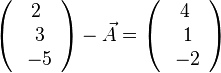
| + | b) <math>\vec {AB} = \vec B-\vec A = \left ( \begin{array}{c} 4 \\\ 1 \\\ -2 \end{array}\right)</math>, also <math> \left ( \begin{array}{c} 2 \\\ 3 \\\ -5 \end{array}\right) - \vec A = \left ( \begin{array}{c} 4 \\\ 1 \\\ -2 \end{array}\right)</math> oder <math>\left ( \begin{array}{c} 2 \\\ 3 \\\ -5 \end{array}\right) -\left ( \begin{array}{c} a_1 \\\ a_2 \\\ a_3 \end{array}\right) = \left ( \begin{array}{c} 4 \\\ 1 \\\ -2 \end{array}\right)</math> liefert <math>a_1 = -2, b_2 = 2, b_3=-3</math>. | ||
| + | |||
| + | c) <math>\left ( \begin{array}{c} b_1 \\\ 0 \\\ 7 \end{array}\right) -\left ( \begin{array}{c} 2 \\\ a_2 \\\ a_3 \end{array}\right) = \left ( \begin{array}{c} 4 \\\ 1 \\\ -2 \end{array}\right)</math> liefert <math>b_1 = 6, a_2=-1, a_3=9</math> | ||
| + | |||
| + | d) <math>\left ( \begin{array}{c} -a \\\ a \\\ 3a \end{array}\right) -\left ( \begin{array}{c} a \\\ -3 \\\ 2a \end{array}\right) = \left ( \begin{array}{c} 4 \\\ 1 \\\ -2 \end{array}\right)</math> liefert <br> | ||
| + | x<sub>2</sub>-Koordinate: a + 3 = 1, also a = -2 und <math>\vec A= \left ( \begin{array}{c} -2 \\\ -3 \\\ -6 \end{array}\right)</math> und <math>\vec B = \left ( \begin{array}{c} 2 \\\ -2 \\\ -6 \end{array}\right)</math> }} | ||
| + | |||
| + | Buch S. 93 / 3b | ||
| + | |||
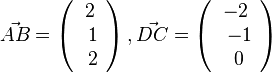
| + | {{Lösung versteckt|1=<math>\vec {AB} = \left ( \begin{array}{c} 2 \\\ 1 \\\ 2 \end{array}\right), \vec {DC}=\left ( \begin{array}{c} -2 \\\ -1 \\\ 0 \end{array}\right)</math> }} | ||
| + | |||
| + | <ggb_applet height="500" width="600" | ||
| + | filename="93-3b.ggb" /> | ||
| + | |||
| + | Buch S. 93 / 4 | ||
| + | |||
| + | {{Lösung versteckt|1=a) Die Punkte werden im Gegenuhrzeigersinn bezeichnet. Die untere Grundfläche hat die Punkte H, A, M, I, die obere Grundfläche die Punkte L, T, O, N. Also liegt H und L, A unter T, M unter O und I unter N.<br> | ||
| + | T,O,N werden durch L(4;-4;0) zu einem Quadrat ergänzt.<br> | ||
| + | O(0,0,0) und M(0,0,-4) bedeuten, dass die untere Fläche 4 unterhalb der oberen Fläche liegt.<br> | ||
| + | Damit: T(4;0;0) liefert A(4;0;-4), N(0;-4;0) liefert I(0;-4;-4) | ||
| + | Nun ergeben sich noch H(4;-4;-4), A(4;0;-4), M(0,0,-4).<br> | ||
| + | Also insgesamt: H(4;-4;4), A(4;0;-4), M(0;0;-4), I(0;-4;-4) und L((4;-4;0), T(4;0;0), O(0;0;0), N(0;-4;0)<br> | ||
| + | |||
| + | Da O der Ursprung ist, ist ein Vektor <math>\vec {OM}</math> mit Startpunkt O der Ortsvektor <math>\vec M</math>. | ||
| + | <math>\vec {OM}= \vec M = \left ( \begin{array}{c} 0 \\\ 0 \\\ -4 \end{array}\right), \vec {OL} = \vec L = \left ( \begin{array}{c} 4 \\\ -4 \\\ 0 \end{array}\right), \vec {MH}=\vec H - \vec M = \left ( \begin{array}{c} 4 \\\ -4 \\\ 0 \end{array}\right), \vec {IA}=\vec A - \vec I = \left ( \begin{array}{c} 4 \\\ 4 \\\ 0 \end{array}\right) </math><br> | ||
| + | <math>\vec {NT} = \vec T - \vec N = \left ( \begin{array}{c} 4 \\\ 4 \\\ 0 \end{array}\right), \vec {LA} = \vec A - \vec L =\left ( \begin{array}{c} 0 \\\ 4 \\\ -4 \end{array}\right), \vec {AN} = \vec N - \vec A = \left ( \begin{array}{c} -4 \\\ -4 \\\ 4 \end{array}\right)</math> <br> | ||
| + | Man kann die Koordinaten auch gut als als Wege wie man vom Anfangspunkt zur Spitze des Vektors gelangt. Beim letzten Vektor <math>\vec {AN}</math> geht man von A aus -4 in x<sub>1</sub>-Richtung und kommt zur x<sub>3</sub>-Achse, dann geht man um -4 in x<sub>2</sub>-Richtung, dann ist man unterhalb von N und muss noch um 4 in x<sub>3</sub>-Richtung und ist dann in N. | ||
| + | |||
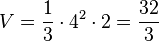
| + | b) Die Pyramide hat ein Quadrat mit Seitenlänge a = 4 als Grundfläche und die Pyramidenhöhe 2, also ist <math>V=\frac{1}{3} \cdot 4^2 \cdot 2=\frac{32}{3}</math><br> | ||
| + | Die Oberfläche hat den Inhalt <math>O=4^2 + 4\cdot \frac{1}{2}\cdot 4 \cdot 2\sqrt 2 = 16+16\sqrt 2=16(1+\sqrt 2) \approx 38,6</math> }} | ||
| + | |||
| + | <ggb_applet height="500" width="600" | ||
| + | filename="93-4.ggb" /> }} | ||
Version vom 10. Januar 2021, 07:44 Uhr
Aus der Physik kennt man Größen wie Geschwindigkeit, Impuls, Kraft, die nicht nur einen Betrag sondern auch eine Richtung haben. Die Richtung wird durch einen Pfeil angegeben. Je Größer die Geschwindigkeit, der Impuls, die Kraft ist desto länger ist der Pfeil.
In der Mathematik kennt man Pfeile oder Vektoren von einer Verschiebung. In diesem Video
wird erkärt wie man eine Verschiebung im R2 mit Hilfe eines Vektors beschreibt.
Dieses Vorgehen übertragen wir auf unseren Raum R3. Stellt man Betrachtungen in der Zeichenebene R2 an, so setzt man die dritte Koordinate x3 einfach 0.
 Merke:
Ein Vektor ist die Menge aller gleich langen, parallelen und gleichgerichteten Pfeile. Jeder Pfeil ist ein Repräsentant des Vektors. Jeder Repräsentant legt den Vektor fest. In einem Koordinatensystem legt man einen Vektor
Für Vektoren verwendet man eine Spaltenschreibweise Der Pfeil Sind die Pfeile zweier Vektoren Ein Vektor der Länge 0 wird mit |
 bezeichnet.
 .
.
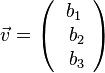 oder
oder 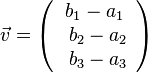 .
. 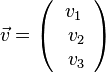 und der Vektor
  heißen Koordinaten des Vektors
  vom Ursprung O des Koordinatensystems zum Punkt P(p1;p2;p3) heißt Ortsvektor
  des Punktes P. Es ist
 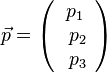 . Der Punkt P und sein Ortsvektor
  .
.
 bezeichnet.
 und heißt Nullvektor. Es ist
  .
.
Beispiele
1. Der Vektor  mit A(4;3;1) und B(-1;6;0) ist
 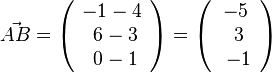 .
.
Sein Gegenvektor  ist dann
 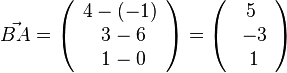 .
.
Der Ortsvektor  vom Ursprung zu A ist
  , der Ortsvektor
  ist
ist 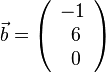 .
.
2. Die Pfeile und  gehören zum selben Vektor
  .
.
Gegeben sind A(2;3;4), B(4;7;1) und C(1;5;6). Welche Koordinaten hat D?
Es ist 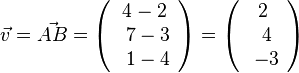
Andererseits ist 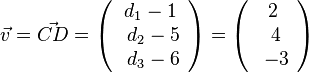 . Durch Vergleich der Koordinaten
  erhält man
  , also D(3;9;3).
| Merke:
Der Betrag Hinweis: Die Länge eines Pfeils des Vektors ist die Länge der Diagonale eines Quaders mit den Koordinaten als Länge, Breite und Höhe. |
 des Vektors
  .
.
 b)
b)  c)
c)  d)
d)  e)
e) 
 , b)
, b) 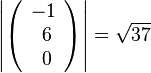 , c)
, c) 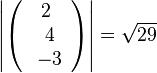 , d)
, d) 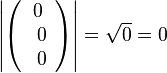 , e)
, e) 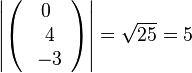





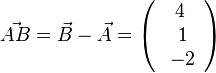 , also
  oder
oder 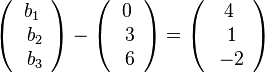 liefert
  .
.
 oder
oder 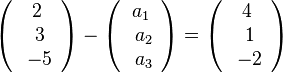 liefert
  .
.
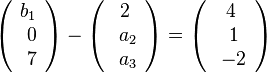 liefert
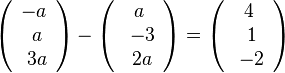 liefert
 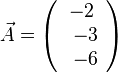 und
und 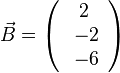
 mit Startpunkt O der Ortsvektor
  .
.


 geht man von A aus -4 in x1-Richtung und kommt zur x3-Achse, dann geht man um -4 in x2-Richtung, dann ist man unterhalb von N und muss noch um 4 in x3-Richtung und ist dann in N.